OPIDN and SWS overexpression flies still have 50% of the phospholipase/esterase activity found in wild type after TOCP treatment. If OPIDN results solely from reduced phospholipase activity, SWS overexpression and the resulting increase in activity should prevent or at least reduce the toxic Epimedoside-A effects after TOCP exposure. Furthermore, reducing the levels of SWS by treating heterozygous sws1 flies did not increase the toxicity, but protected the flies form behavioral deficits and neurodegeneration. That sws1 heterozygous flies were protected from the delayed symptoms caused by TOCP and SWS overexpressing flies were more sensitive, at least when analyzing the degeneration, strongly suggested that the delayed phenotypes are caused by another function of SWS, than the phospholipase function. It also supported 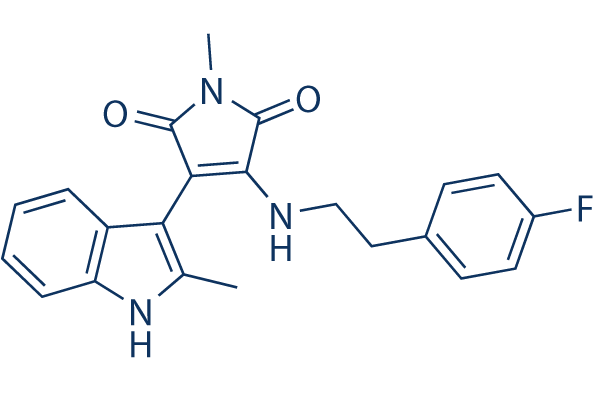 the hypothesis that these defects are caused by inducing a toxic gain-of function which is prevented when the amount of the toxic, TOCP-modified SWS is reduced, as in the case of sws1 heterozygous flies. Surprisingly, changes in SWS levels had no effect on the TOCP-induced neurite shortening in primary neuronal cultures, suggesting that this acute phenotype is due to a different toxic mechanism of TOCP. Indeed, treatment with paraoxon, a potent AChE inhibitor that does not induce OPIDN resulted in a very similar neurite retraction, further supporting our assumption that mechanisms of the acute toxicity are different or might even not be mediated by NTE. We previously described that SWS can act as a non-canonical regulatory subunit of protein kinase A by binding and inhibiting the C3 catalytic subunit. We therefore tested whether the gain-of function effect of TOCP on SWS could be due to altering the interaction of SWS with PKA-C3. Indeed, exposing flies to TOCP resulted in a significant decrease in PKA activity, a result that was confirmed for vertebrate NTE using rat primary neurons. Like SWS, rodent NTE did bind to the C3 subunit whereas it did not interact with the other two catalytic subunits of assumption that mechanisms of the acute toxicity are different or might even not be mediated by NTE. We previously described that SWS can act as a non-canonical regulatory subunit of protein kinase A by binding and inhibiting the C3 catalytic subunit. We therefore tested whether the gain-of function effect of TOCP on SWS could be due to altering the interaction of SWS with PKA-C3. Indeed, exposing flies to TOCP resulted in a significant decrease in PKA activity, a result that was confirmed for vertebrate NTE using rat primary neurons. Like SWS, rodent NTE did bind to the C3 subunit whereas it did not interact with the other two catalytic subunits of flies, suggesting that the PKA-regulatory function is conserved in vertebrate proteins. In this context, it is noteworthy to mention that vertebrates have a C3 orthologous catalytic subunit, called Pkare in mouse and PrKX in humans, and that these subunits are more conserved between the different species than they are related to different subtypes from one species. As observed in flies, TOCP treatment of hippocampal neurons reduced PKA activity, suggesting that TOCP also interferes with the release and activation of the vertebrate catalytic subunits from NTE. To Salvianolic-acid-B obtain further support for our model that reduced PKA activity plays a role in the delayed symptoms of OPIDN, we used flies that expressed additional PKA-C3 and indeed this protected them from TOCP-induced behavioral and degenerative defects.
Consistent with this result PKA-C3 expression increased PKA activity in other species that NTE has to be inhibited
Leave a reply
 chronic MI. Collectively, these studies suggest that inhibition of miR-34a provides some benefit in an acute setting of cardiac stress or conditions with moderate pathology, but not in chronic or severe settings. A possible explanation for the reduced
  study of 1028 STEMI patients we found no association between levels of IL-6, sgp130 and sIL-6R, measured median 18 hours after PCI, and myocardial injury measured as peak TnT. Our data on STEMI patients with acute de novo HF are in accordance with these results. We have previously shown that levosimendan improved LV function compared to placebo in post-ischemic myocardium in patients developing acute HF following a PCI-treated STEMI, however no significant effect on levels of N-terminal proB-type natriuretic peptide was found. The lack of significant between-group differences in changes of the measured markers during the study period between levosimendan and placebo differ from findings in previous studies on patients with HF. However, patients in these studies had decompensated chronic HF with LV ejection
  Amino acids in these regions should not be described as equivalent and comparisons between sub-types has little biological relevance. Many studies attempt to compare, and sometimes replicate, mutations seen in one subtype, such as H5, to those in another subtype. Careful consideration of the level of structural and functional conservation of that region, however, is crucial. This is especially important when inferring analogous mutations from subtypes belonging to a different phylogenetic group. We feel that the use of this set of residue numbering and analysis of structural conservation will facilitate cross-subtype comparisons and reduce confusion in reporting amino acid numbering. The present substudy of the LEAF trial is the first to explore possible associations between inflammatory markers and LV function and
  fresh and clean as they were immediately after flaying. With the exception of draw, which was considerably better on the irradiated sides compared to the brine sides, all of the parameters measured were equivalent for both preservation treatments. Vankar and Dhivehi proposed that commercial scarcity and the cost of consumption of the above-mentioned curing processes do not invite flayers to follow these new methods. These suppliers who supply 60�C70% of raw skins for total consumption to the leather industry require a cheap strategy. Hence, the development of an alternative curing technique should proceed in such a way that the practices and socioeconomic feasibility can be maintained at equilibrium. It is known that lowering the temperature decreases the pace of bacterial growth. The rate of collagen and non-collagenous protein degradation and microbial population dynamics were found to vary with temperature and storage periods. Of course, hide/skin can be frozen, and then stored sufficiently for a long time, but the structure of hide/skin under freezing conditions changes undesirably due to the formation of ice crystals. One of the alternative methods could be storage of hide in vacuum under low temperatures, as used for certain foods. This method could help to avoid pollution with salt and buried raw hides. On the other hand, vacuum preservation can only be applied in practice after thorough exploration of the method. The vacuum is widely used in leather processing for leather drying, as it offers fast speed at a low temperature, which would be advantageous for heat-vulnerable chrome-free leather. Several attempts have been made to use vacuum for other leather processing steps, including leather tanning. The results acquired results show that, on the